A month into the infamous Fuel Price Hike: Synopsis and some overlooked Substitutes.

Background Overview

๐ŸŽฏ Recent Developments

(7 June 2020 – 7 July 2020)

  • Petrol and Diesel prices remained unchanged in the metros on Monday, a week of no change following three weeks of daily hikes
  • Starting from June 7, fuel prices went up for a consecutive of 22 days.
  • The prices of Petrol and Diesel have gone up cumulatively by Rs 9.13 and Rs 11.1 respectively since June 7, in Delhi
  • The Top 12 cities are now paying Rs 80 or more for a Litre of petrol
  • Indians pay over 250% collectively in excise duty to state and centre
  • India has the highest tax rates on fuel as compared to any other country in the entire world
  • The base price of petrol is at Rs 18 while over Rs 50-per-Litre are levied on top of it in the form of taxes
  • Central taxes per Litre are almost twice of the State taxes
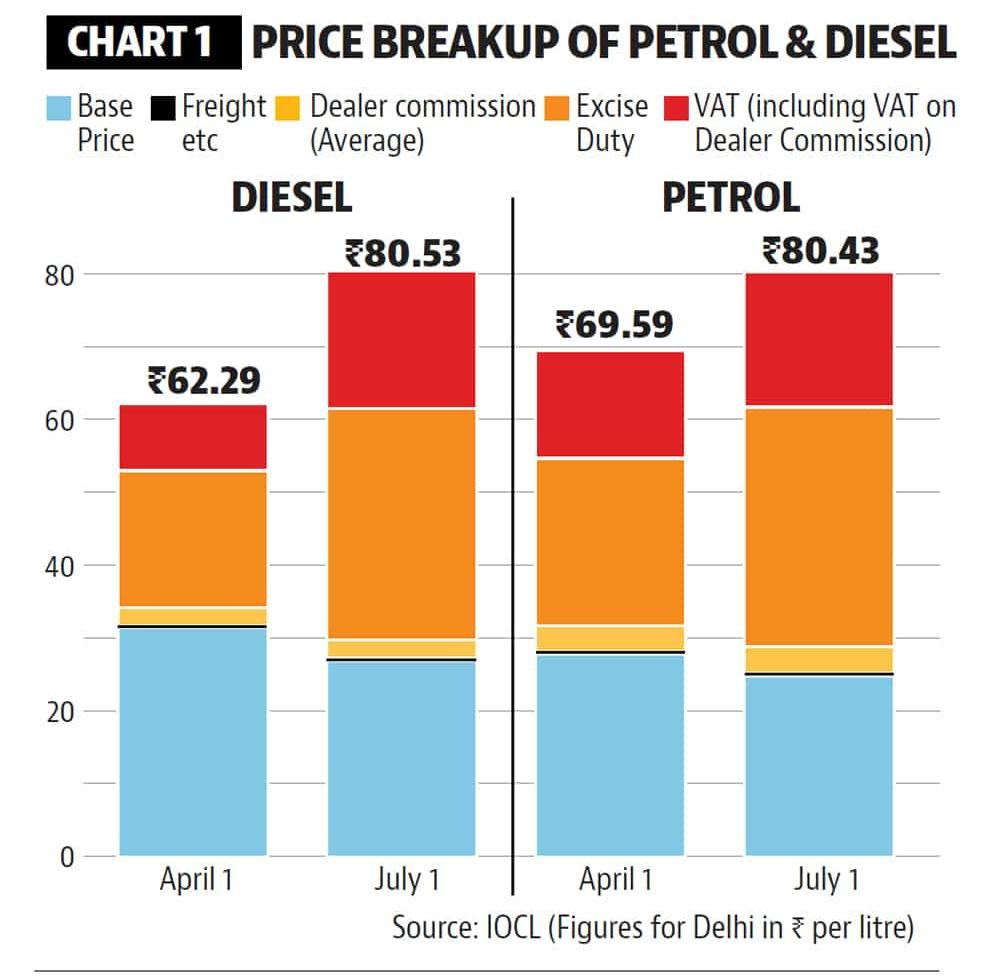
As of today, nearly two-thirds of the Petrol and Diesel price paid by the consumers are taxes. In the case of Petrol, the total tax is 64 percent followed by 63 percent for Diesel.

In absolute terms, tax amounts to over Rs 50 for a Litre of Petrol and Rs 50-55 for a Litre of Diesel. In both cases, around 60% per cent of taxes go to the Centre as excise duty and the rest to states as VAT.

This continuous rise in the Fuel Prices are the result of  hiked excise duty by Central Government on Petrol and Diesel by Rs 3 per Litre (each) on March 14 and then again on May 5 by a record Rs 10 per Litre in case of petrol and Rs 13 for Diesel. The two hikes gave the government Rs 2 lakh crore in additional tax revenues. Also, a rise in value-added tax (VAT) by some state governments and union territories during the past months further resulted in aggravated prices of Fuel.

What are the effects of the Fuel Price Hike on the other Sectors?
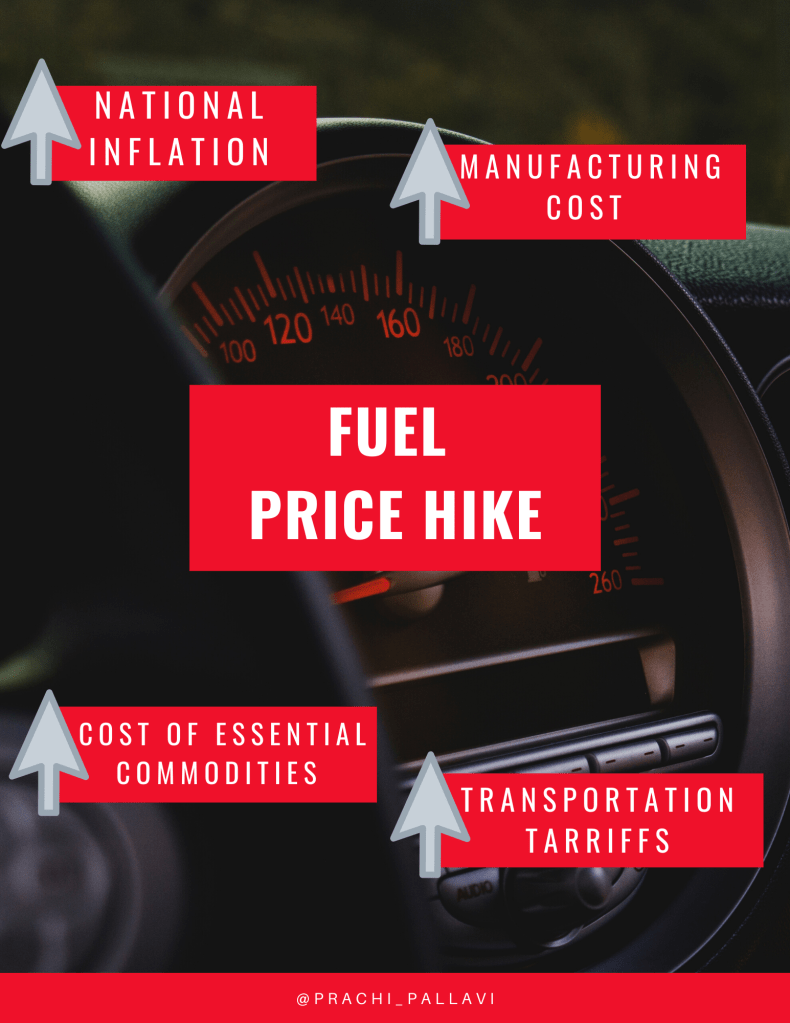
  1. Record high prices for Diesel means that the cost of transporting goods goes up across the country. In turn, prices of essential commodities like fruits and vegetables as well as other goods increases.
  2. Fuel hike leads to an increase in transportation tariffs.
  3. The increase in fuel price also impacts Electricity sector as it leads to an increase in production costs for generating electricity.
  4. Manufacturing in Chemical sector, where Petrol is an important component, is also affected.
  5. The fuel price hike has an impact on each economic sector, by increasing the cost of production and thus leads to national inflation. Inflation rises in line with the rise in fuel prices.

With the above mentioned figures, the motive behind the fuel hike is crystal clear, that is, both the Central Government and State Government is burdening the common people to generate additional revenues. But, Is burdening the Common people only way to generate revenue? Are there no other alternatives available?

To understand other viable options, we first need to understand that Why The Government of India did not follow the trend of decreasing fuel prices as observed in the other nations? Why did it keep on maintaining economic pressure on it’s citizens, when a disaster like COVID-19 has already narrowed down the chances of one’s survival?

Answer to this question can be understood from the following points:-
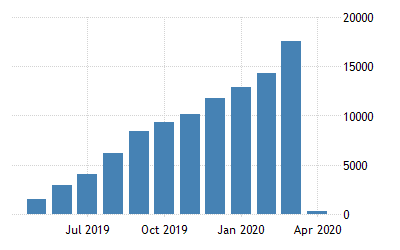
Government Revenues in India Unit: INR Billion [Source: Trading Economics]
  • Firstly, in the course of duration of the COVID-19, the revenue of  the Indian Government decreased to 275.48 INR Billion in April from 17507.27 INR Billion in the March of 2020.
  • Secondly, with COVID-19 affecting every Sector of the economy, the Formal Sectors (Tax Paying Services) are changing to the Informal Sectors.
  • Increase in non-filing of returns has also been observed (the “Lock Down Effect”).
  • Depreciation in the value of the Indian Rupee currency (INR).

Thus, both the Central and the State Government, did not fail to spot any opportunity  to generate additional revenue – whether it be from an increase in the taxes levied on Fuel (or Booze).

This bring back us to the same question- Is burdening the Common people the only way to generate revenue? Are there really no other viable alternatives in these tough times?

The answer to this question is a BIG NOOOOOOOOO.

There are several other ways with which revenue can be generated by the Indian Government, without squeezing every penny from the Common Mans pocket. Here, a few of them have been enlisted :-

โ€ข Taxing the Wealthy๐Ÿ’ฒ

The Government needs to raise additional revenue, but that should be done in ways that must not burden the already distressed common man. In view of several European economists, taxing the wealthy would be the most โ€œprogressive fiscal toolโ€, as wealth is far more concentrated than income and consumption. According to a survey conducted by Oxfam, 58% of Indiaโ€™s total wealth is concentrated within 1% of its population.

This super rich segment of the population can be taxed through two alternative means, both of which can be imposed for a limited / fixed period of time –

Raising highest slab rate to 40% for total income levels above a min. threshold of Rs. 1 cr.

Or

Re-introduction of the Wealth Tax for those with net wealth of Rs. 5 crores or more.

The revenue gain associated with both of these options should be worked out to figure out which of them is better in terms of cost-benefit analysis, as implementation rate of both the schemes differ. But it is well known everywhere that the rich has more obligation for the country as around 75% of the GDP is controlled by only 10% of the population.

โ€ข Mobilization of CSR Funds for COVID relief.

The tax incentives for CSR should be extended at the time of this National disaster. Those companies who are undertaking the COVID relief activities under CSR should be allowed to claim as expenditure incurred for the purpose of business deduction section 37 for Financial Year 2020-21 only. This incentive helps in mobilizing CSR funds for the disaster management.

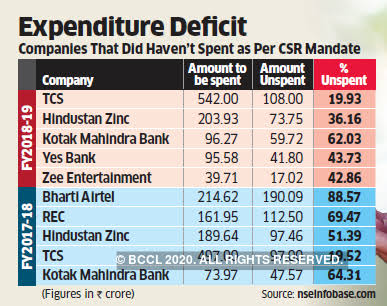
As per the current law, specified class of companies are required to spend 2 per cent of their average net profits as CSR, failing which the Board has to incorporate the reasons for such failure in its report. The Government can propose to provide a one-time opportunity to the companies to contribute a portion of their unspent CSR funds till FY 2019-20 to COVID Relief Fund.
โ€ข  Postponing Central Vista Project

The Redevelopment Project of Central Vista – the nation’s power corridor envisages a triangular Parliament building next to the existing one, a common Central Secretariat and revamping of the 3-km-long Rajpath — from Rashtrapati Bhavan to India Gate. This project is estimated to cost Government a fortune of Rs. 15,000 Crores to Rs. 20,000 Crores. The Indian Government should consider to delay spending for this purpose and use it for developing Health Infrastructure, or for other much more important projects. A Rs. 20,000-Crore redevelopment plan should be last on the Government’s priority list as the entire nation is reeling under the coronavirus crisis.
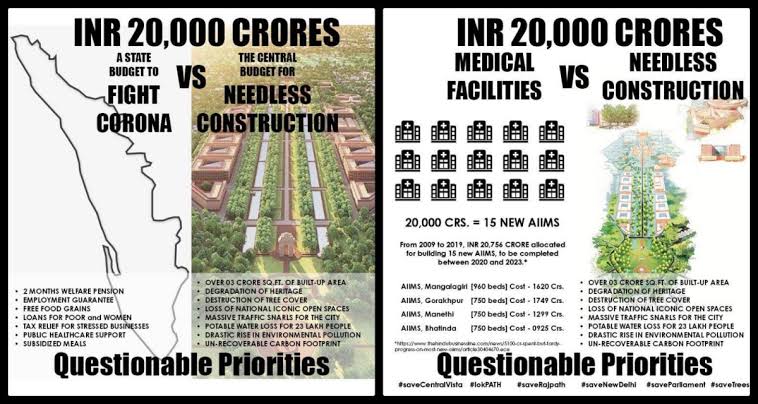
[Source: The Wire]

Delaying of the project for 2-3 years would not affect the Parliament gravely, as it has been doing just fine till the present times.

โ€ข Halting Infrastructure Expenditures

In Financial Year Budget 19-20, the Government of India announced allocation of Rs 94,071 crore to the Ministry of Railways for Infrastructure Development. There is a need to re-orient the expenditure budget as presented in February, 2020. Amidst of COVID-19, The Government can look into cutting these budgets and investing more towards the Health Sector, thereby making it the Power Sector for the Indian Economy, which in the future can result in much greater revenues. Government should invest as much as it can in health sector and make it the driving force of the Indian Economy.

The Government also announced to invest Rs 10,000,000 crores ( US$ 1.5 trillion ) in infrastructure over the next five years. Such Infrastructure development should be delayed for at least a year or two so that the overburden on the Common Man due to taxes and inflation can be lifted.

โ€ข Increasing International Taxation

Taxation System

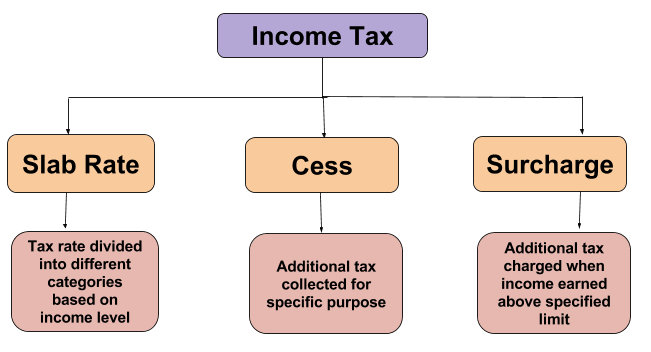
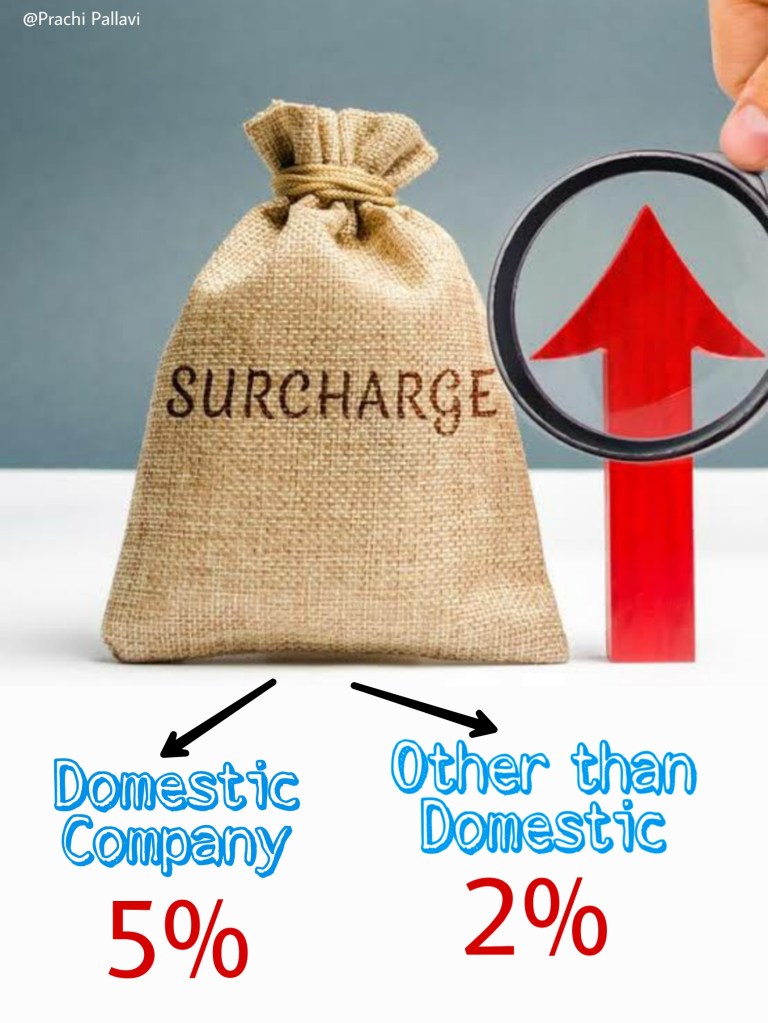
The Government can increase the surcharge applicable to the Higher income Foreign Companies having a Branch Office/ Permanent Establishment in India. The said surcharge has not been revised for quite some time.

Foreign Companies are taxed at a rate of 40%. Added to the tax amount is:

  • Surcharge on tax:
  • 2% in cases where annual income is between Rs. 1 Crore to Rs. 10 Crore
  • 5% in cases where annual income is more than Rs. 10 Crore

The Government can increase the surcharge for Foreign establishment earning more than 10 Crore as cess for COVID-19.

Note: Domestic companies are paying more Surcharge (as for now) than the Foreign Companies.
โ€ข Rationalization of Equalization Levy

โ€œEqualization Levyโ€, also known as โ€œGoogle Taxโ€, was introduced by the Finance Act, 2016 on certain non-resident businesses on certain โ€œspecified servicesโ€, largely those providing advertisement space and services. The revenues are taxed at 6% on gross basis. Finance Bill, 2020 proposes to expand the scope of the โ€œequalization levyโ€ to include consideration received by e-commerce operators from e-commerce supply or services, and taxed at a rate of 2%. The Corona economy is largely a digital/online / e-commerce economy. The consumption of online services, especially web streaming services such as Netflix, Amazon Prime, Zoom, etc. and the increased dependence on online commerce has made this sector flourish. The increased business of these e-commerce/ online streaming/ web service companies provides an opportunity to increase the said tax rates by 1%, i.e. from 6% to 7% for ad services, and from 2% to 3% for e-commerce.

โ€ข Reintroduction of the ‘ Inheritance Tax ‘

Inheritance tax is levied mostly in developed countries, at rates as high as 55%. In India, it was levied till 1985, payable on a slab basis which ranged from 10% to 85%. Earlier, procedural issues, information asymmetry and implementation problems lead to the tax being abolished. However, in todayโ€™s digital age, information is easily accessible, and with the improvements in administrative framework over the last few decades, such a tax is enforceable and implementable now. Inheritance tax, if reintroduced, is expected to reduce concentration of wealth, widen the tax base and enhance revenue, and play its part in bridging the wealth inequality. The richest 10% of Indians own 77.4% of the countryโ€™s wealth. The bottom 60%, which is the majority of the population, owns 4.7%. The richest 1% own 51.5%. There is a huge gap between the rich and the poor, and Inheritance tax can bring equality in distribution of income and wealth. More importantly, such tax may eventually lead to reduction in tax rates.

However, it is important to note that reintroduction should be carefully thought through with fair exemptions or limits and only under specified circumstances.

References

https://www.google.com/amp/s/www.livemint.com/money/personal-finance/union-budget-2019-is-it-viable-to-reintroduce-estate-tax-in-the-upcoming-budget/amp-1562000837590.html

https://www.ibef.org/economy/union-budget-2019-20#:~:text=The%20Union%20Budget%20for%202019,Parliament%20on%20July%2005%2C%202019.&text=Total%20expenditure%20for%202019-20,-19%20(budget%20estimates).

https://www.google.com/amp/s/taxguru.in/income-tax/fiscal-options-response-covid-19-epidemic.html%3famp

https://www.google.com/amp/s/www.charteredclub.com/surcharge-on-income-tax/amp/
https://www.google.com/amp/s/m.hindustantimes.com/india-news/the-political-economy-of-petrol-diesel-price-hike/story-n1wUkMkOa86mPvgNng0LsJ_amp.html

India’s response to Covid-19 : What has been done & what more could be done?

A fight for survival.

What will damage India to a greater extent – Covid-19 or the downfall of the Indian economy?

Background Overview

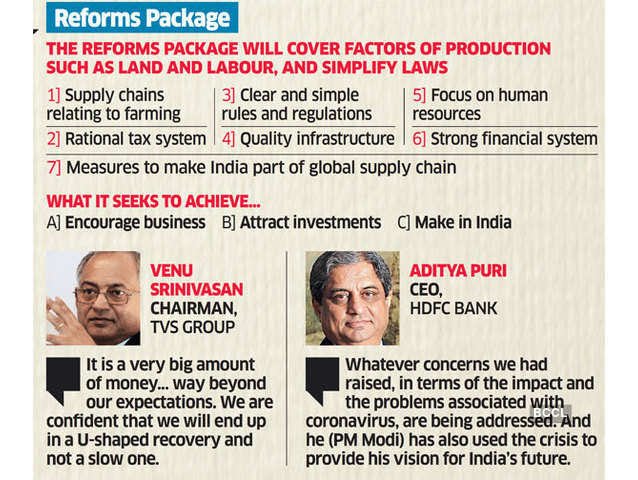
Recently, PM Modi announced a stimulus package worth Rs. 20-lakh-crore, equivalent to about 10% of our GDP, which is aimed at making the country self-reliant and reviving the stalled economy. Details of the plan, dubbed the Atmanirbhar Bharat Abhiyaan, are being unveiled by the finance minister- Nirmala Sitharaman, since Wednesday.

India fights against COVID-19 [Credit: Economic Times]

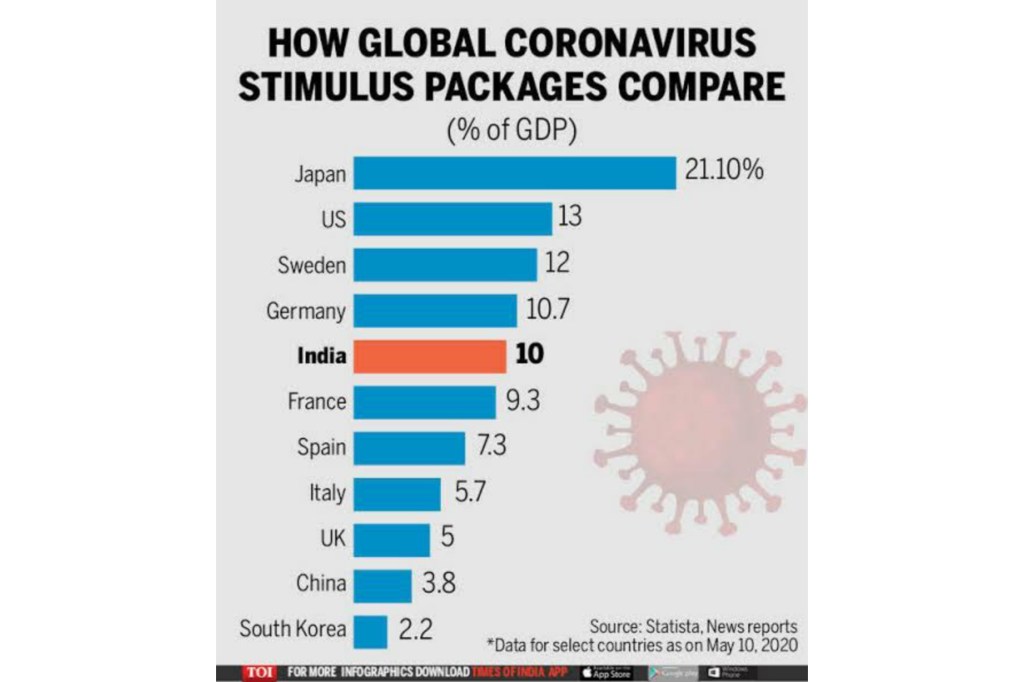
The so called Aatmanirbhar Bharat package includes measures to save the lockdown-battered economy, and focuses on tax breaks for small businesses as well as incentives for domestic manufacturing. The combined package is roughly 10 per cent of the GDP, making it one of the most substantial in the world after the financial packages announced by the United States, which is 13 per cent of its GDP, and by Japan, which is over 21 per cent of its GDP.
The Rs. 20 lakh crore package includes a Rs. 1.7 lakh crore package for provision of foodgrains to the poor (at no cost) and cash to poor women and the elderly, announced in March, as well as the Reserve Bank’s liquidity measures and interest rate cuts. While the stimulus given in March was 0.8 per cent of GDP, RBI’s cut in interest rates and liquidity boosting measures totaled to 3.2 per cent of the GDP (about Rs 6.5 lakh crore).

This Aatmanirbhar package focuses on land, labour, liquidity and laws and caters to various sections, including cottage industry, MSMEs, labourers, middle class, and industries. However, detailed announcements are being made in tranches.

The announcements on May 13, the first tranche, included six measures for MSMEs, 2 for EPF, 2 for NBFCs and MFIs, 1 for discoms, 1 for contractors, 1 for real estate sector and 3 tax measures.

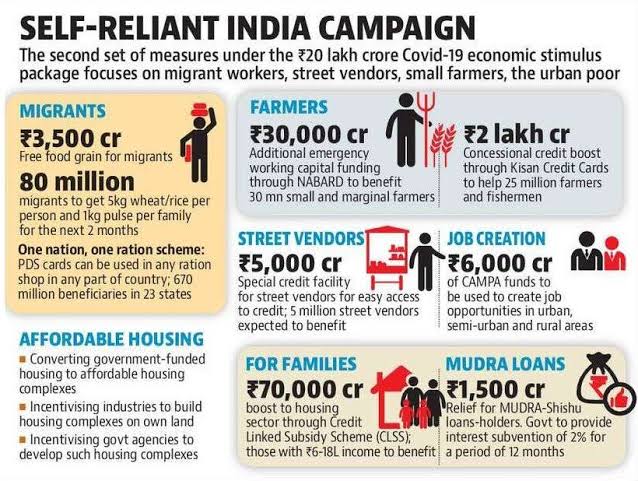
The second tranche on released on May 14 by FM focused on migrant workers, street vendors, small traders, self-employed people and small farmers.

May 14 major announcements (Second tranche)

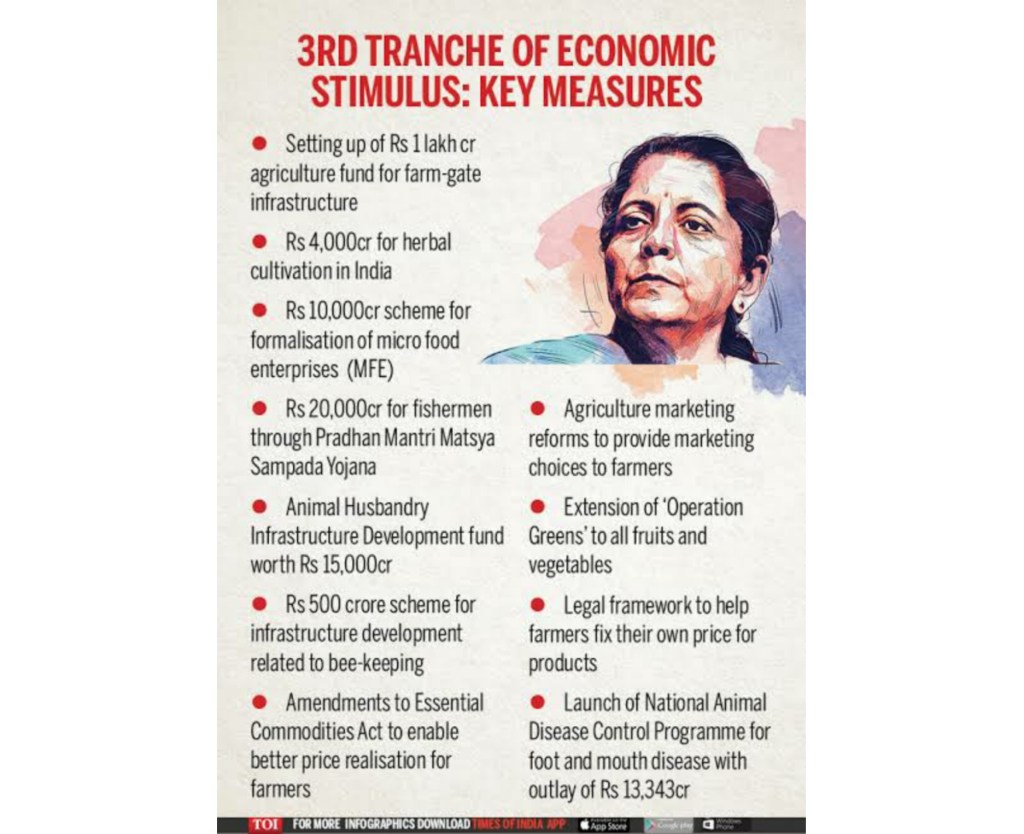
The third tranche on May 15 outlined measures for the Agriculture and allied sectors, along with small farmers whose details are given in the image attached.

Distribution of 1.5 lakh crore released in Part-3 [Credit: TOI]

From Mining and Aviation to Defence and Space, the fourth tranche announcements via FM Nirmala Sitharaman focused on boosting structural reforms in the industries to enable ease of business.

Tranche 4 Major Announcements

Finance Minister Nirmala Sitharaman announced reforms in seven key areas, which includes MGNREGA, Healthcare and Education, ease of doing business, in the fifth and final tranche of economic stimulus package to deal with the economic fallout of the COVID-19 pandemic. An increase in the borrowing limit for states from 3 per cent to 5 percent was also announced, which would provide them with an additional amount of Rs. 4.28 lakh crore.

Questions that remain unanswered :

After five days of numerous announcements from the Finance Minister, approximately 80% of the BIG BUDGET futuristic use has been shared and keeping the above mentioned distributions in mind, it seems like the Rs 20 lakh crore number is a bit of a narrative, with almost negligible in-hand capital. The package as in whole is not fresh, for one the number includes liquidity announcements already made by the independent Reserve Bank of India. In an effort to ensure that firms have easy access to credit, the central bank made sure to provide cheap money for banks to borrow. Its operations alone account for nearly one-third (โ…“) of the Rs. 20 lakh crore package that the PM referred to.

It’s also important to note that a few major economies would count the central bank liquidity operations as a part of their post-lockdown rebuilding packages. A business journalist Vivek Kaul has pointed out that little of this money is actually being used to shore up the economy. The entire package is not a fresh push, as a large portion of it has already been delivered by the RBI and the government. Technically, this brings down the package to about Rs. 11.02 lakh crore. And after the details provided in the last four days, it’s clear that a major portion of the Aatmanirbhar Bharat package is being used for Industrial Reforms in various sectors, instead of focusing on providing instant relief to the masses, especially laborers and the people who have lost their job during this pandemic. It is important to draw a comparison
between India’s fiscal stimulus and those announced by other countries. This Aatmanirbhar Bharat package focuses on providing shape to rebuilding the economy- but majorly lacks on the part where the instant relief fund comes to light. This Rs. 20 lakh crore package may answer many questions regarding the future, based on rebuilding the shattered economy, but leaves behind many unanswered questions :

โ€ขโ€ข How much does the common man benefit from the Rs. 20 lakh crore economic package announced by the Central Government?

โ€ขโ€ข Is the financial package adequate to bring businesses and small enterprises back on their feet after the Lockdown due to this pandemic is over?

[Credit: TOI]

โ€ขโ€ข Does India need to work on providing direct financial bailouts- both to firms, and industries, crippled by the lockdown as well as the citizens, who have either lost their jobs or have suffered paycuts?

What more could be done?

The universe is so well balanced that the mere fact that you have a problem also serves as a sign that there is a solution.

Steve Maraboli

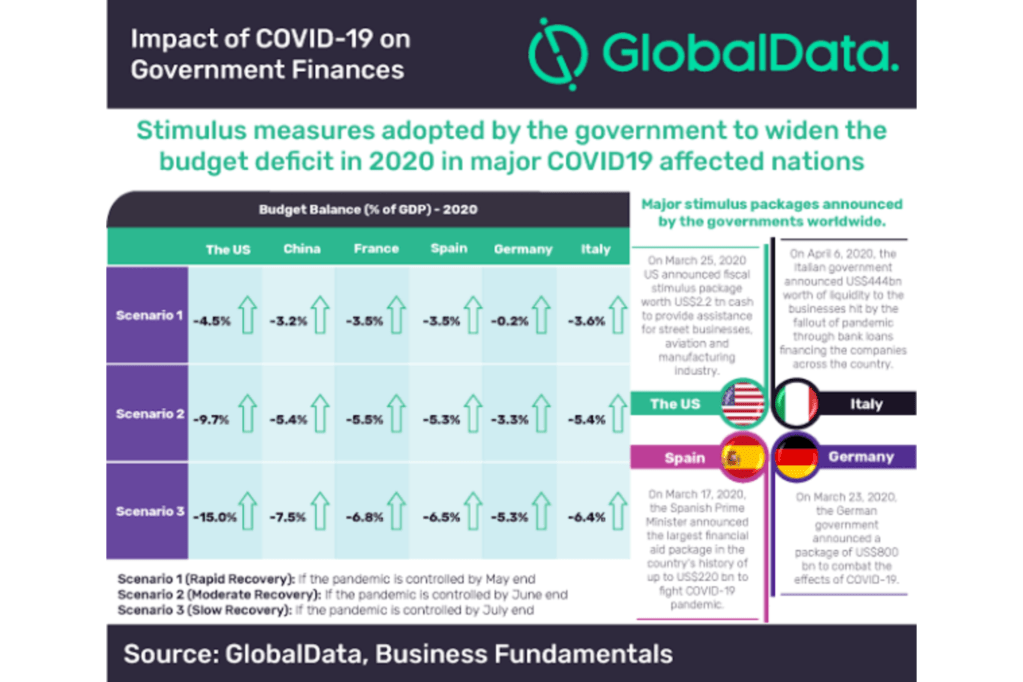
Finding the solution to a problem is easier when the whole world is working on the same issue. Solution of the above unanswered problems can be sought from other countries- like Canada, Germany, Japan etc. as we all suffer from the same problem of our wrecking economy and helpless citizens.

However, it cannot be disagreed with that conditions, GDP, economy, lifestyle and expenditure of every country differs. Even then, a deep research undertaken by me personally enlists some of the steps taken by different Governments worldwide in order to fight the Covid-19 induced crisis :

[Credit: TOI]
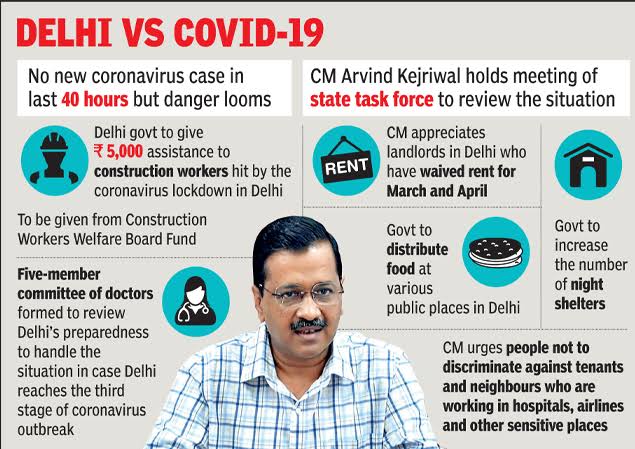
  • According to a recent report published by the World Bank, among all the relief packages announced, 30.7% of the packages are based on cash transfer scheme. 37 Countries have started distributing cash to it’s citizens in order to fight Covid-19 and 88 Countries have increased the amount they have been giving under various Government schemes. Though India is also working on Cash Transfer, but certain factors like limited Cash Transfer and a form filling procedure tends to create some issues- the elderly are not able to stand in lines for hours to get the relief amount. Also the scale of cash Transfer varies from state to state. The Delhi Government is giving Rs 5000 to taxi drivers, while there are some states which are not giving any amount to the needy. Thus, it is important to centrally allocate the funds and provide equal relief to all people.
  • In a country like India ๐Ÿ‡ฎ๐Ÿ‡ณ, Freelance occupation is very common, yet no relief funds have been announced for Freelancers till today. Germany ๐Ÿ‡ฉ๐Ÿ‡ช however, is providing a relief fund of 15000 Euros (12.5 lakh Indian currency) for 3 months to every Freelancer and Small businesses for their sustainment.
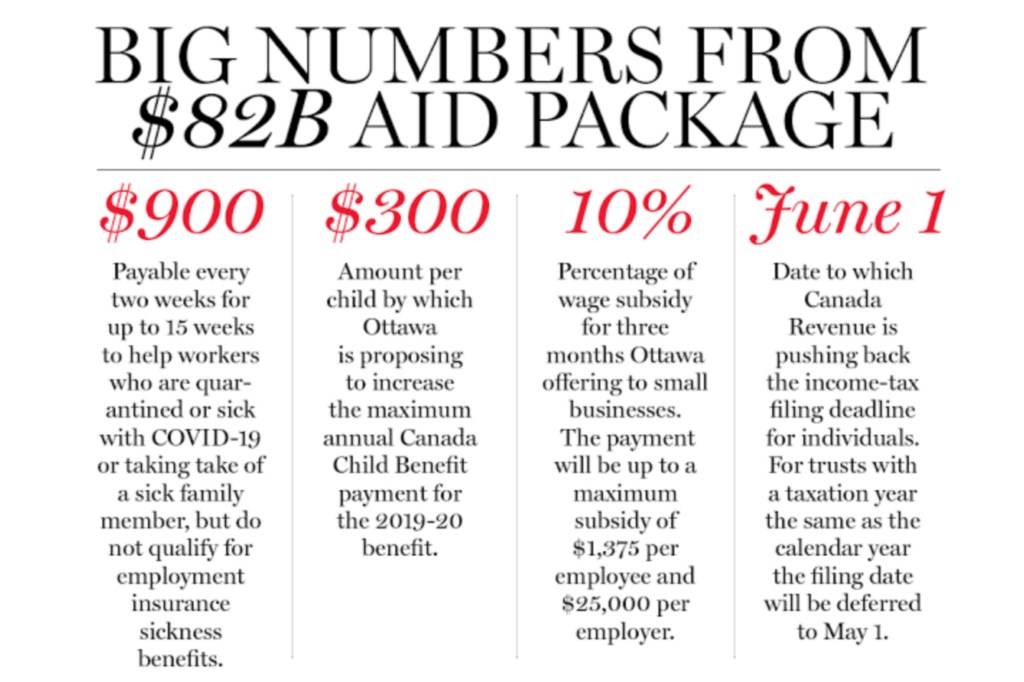
๐Ÿ‡จ๐Ÿ‡ฆ Canada’s Relief Package [Credit: Babara Scecter, Financial Post]
  • In countries like Canada and Germany, relief fund is being provided to parents who lost their job due to Covid-19, in order to provide the necessities to their children and themselves. ๐Ÿ‡ฉ๐Ÿ‡ชGermany for example, is giving 185 Euros per month to single child parents, who lost their job, which is equivalent to 15,500 Indian Currency.
  • Providing loans will help in the uplifment of the Indian Economy, but we cannot ignore the need of cash for survival.
  • Only ๐Ÿ‡ฏ๐Ÿ‡ต Japan has given 2% of its GDP as instant relief fund where each and every citizen of the country has been given 930 Dollars. It is also important to note that Japan has announced a package of 1.1 trillion which is 21.1% of their GDP. However in India, the poor received modest benefits from the first stimulus package – โ‚น500 each to Women Jan Dhan account holders, โ‚น1,000 for senior citizens, poor widows and the differently abled. Not only the relief amount differs massively, but there is also a vast variations in the type of recipients as in India, the money is given only to selective population while in Japan, each and every citizen is given a relief amount.
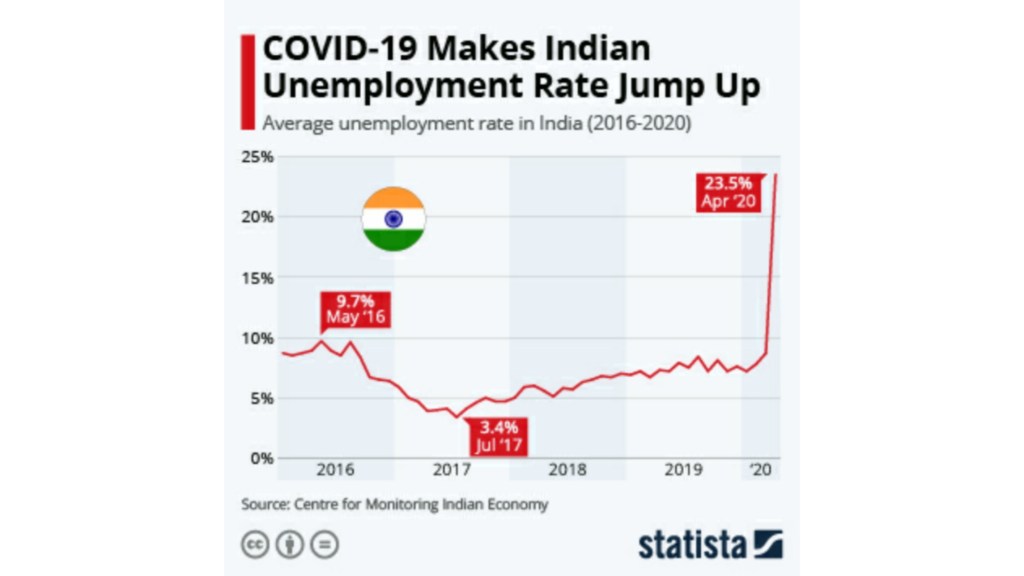
  • In many countries, the Government is paying 2/3 of the salary of small and middle class business workers in order to prevent Job loss. For eg. in ๐Ÿ‡ฉ๐Ÿ‡ฐDenmark, the state will pay 75% of the wages for 3 months, if employers do not lay off their employees. ๐Ÿ‡ฆ๐Ÿ‡น Austrian Government guarantees 90% for gross salaries below โ‚ฌ1,700, 85% for salaries below โ‚ฌ2,685 and 80% for salaries below โ‚ฌ5,370, while apprentices get compensated in full. Such a package is the need of the hour in India as COVID-19 and the nationwide lockdown has resulted in job loss for around 27 million youth in the age group of 20-30 years in the month of April 2020 alone, according to CMIE.
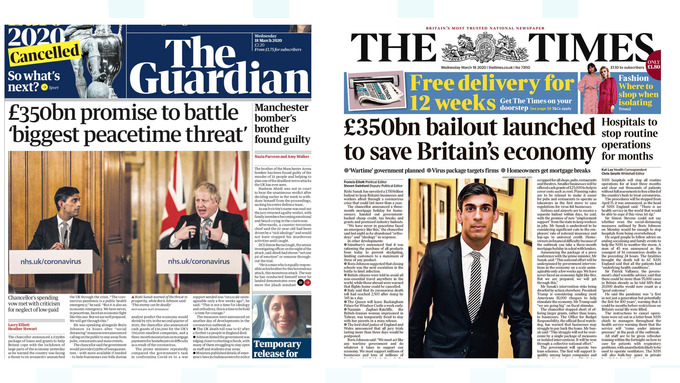
UK’s ยฃ350bn Bailout [Credit: ITV Report]
  • ๐Ÿ‡ฌ๐Ÿ‡ง Britain has offered one of the most generous schemes anywhere in the world, where The Government will pay self-employed people who have been adversely affected by the coronavirus a taxable grant worth 80% of their average monthly profits over the last three years, up to ยฃ2,500 a month. And to minimise fraud, only those who are already in self-employment who have a tax return for 2019 will be able to apply. Such norms, if adopted in India will help more than half of the population.
  • ๐Ÿ‡จ๐Ÿ‡ฆ Canadian Government has released an emergency program of 9 billion Canadian dollars (about$ 6.4 billion) will be put on the Canada Revenue Agency to provide financial assistance to students.Canadian students and recent graduates who have lost income or summer jobs as a result of the COVID-19 pandemic can apply to receive funding from an emergency benefit. Such relief measures are inspiration to all countries.
  • Due to lockdowns closing off many employment sectors in ๐Ÿ‡ฉ๐Ÿ‡ช Germany, low-income workers in catering and hospitality are suffering from their incomes drying up. The German Federal Employment Agency provides short-time unemployment benefits when employers are forced to temporarily shorten workers’ hours. This short-term scheme is designed to prevent people from permanently losing jobs due to “unavoidable” reasons. This new short-term aid package will extend and increase the level of support in stages. Workers who have had their hours reduced by at least 50% will receive an increased payment of up to 77% of total net income after the fourth month of receiving benefits. Those still receiving benefits after seven months will receive between 80 and 87%. The current level of compensation is between 60 and 67%. If applied in India this scheme will be benefit the labourers who are forced to move back to their respective state due to hunger and joblessness.
  • ๐Ÿ‡จ๐Ÿ‡ฆ Canadian Government launched Canada Emergency Business Account (CEBA) The government announced a $25 billion program that will provide interest-free loans of up to $40,000 to small businesses and not-for-profits, to help cover their operating costs during a period where their revenues have been temporarily reduced due to pandemic. The program will be implemented by eligible financial institutions in cooperation with EDC (Export Development Canada). They have also released norms for repaying for eg repaying the balance of the loan on or before December 31, 2022 will result in loan forgiveness of 25% (up to $10,000) and If the loan is not repaid by then, the remaining balance will be converted to a three-year term loan at 5 per cent interest.